
THE COLLAPSE OF 9,000 BUTCHERS: How Supermarket ‘Gas-Flushed’ Meat and the WWF 60:40 Mandate Are Ruining British Beef
Over 62% of independent British butchers have closed in 25 years. Behind the corporate 'protein transition' and fake farm labels lies a reality of water-injected bacon, chemical preservation, and industrial food fraud.
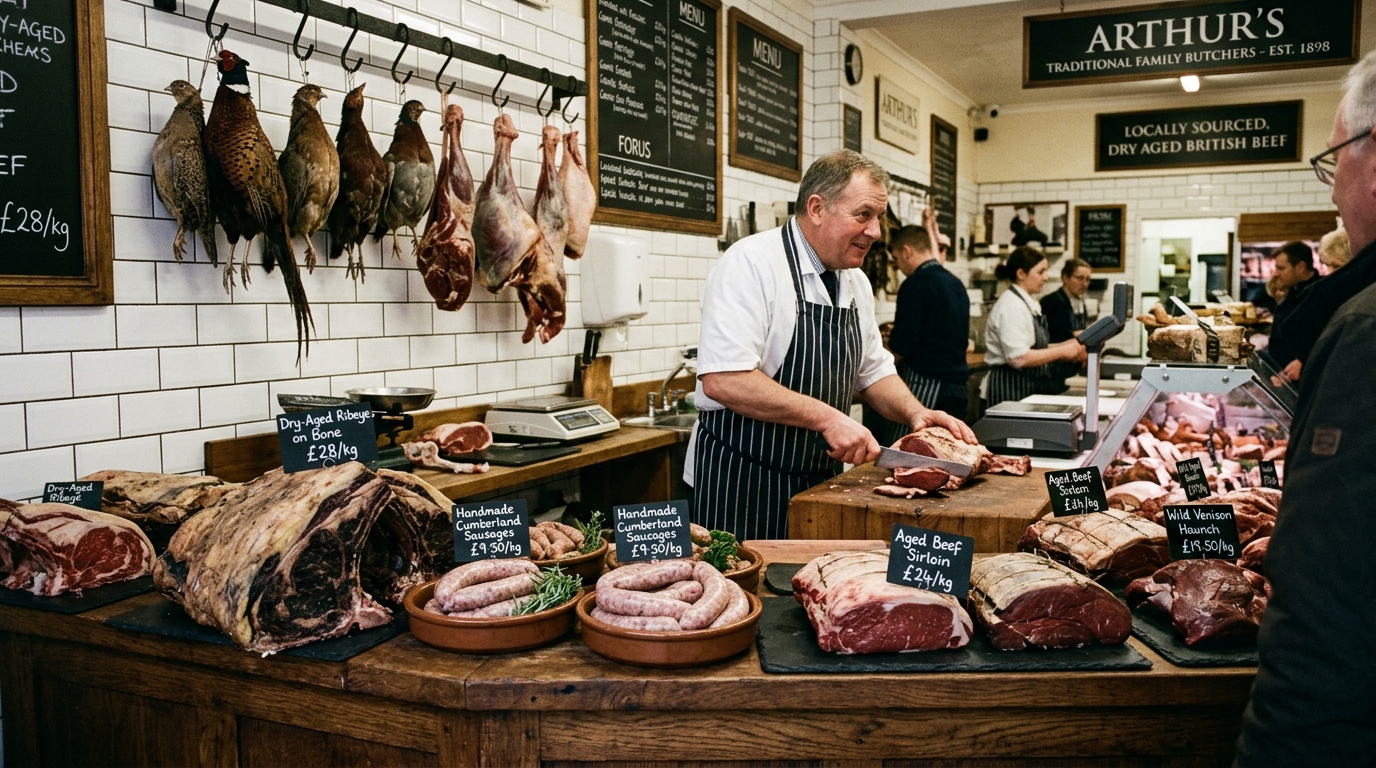
Lead Exposé: Between 1990 and 2024, Britain lost over 9,300 independent butcher shops—a catastrophic 62.4% collapse. Now, with nine major supermarkets signing up to the WWF ‘protein transition’ target forcing a 60:40 shift toward ultra-processed plant foods, the British meat supply chain is facing an existential crisis. Behind deceptive ‘phantom farm’ labels and high-oxygen gas flushing, consumers are paying whole-meat prices for water-pumped, chemically treated commodity meat while our high street craft butchers are pushed to the brink.
Key Evidence & Findings
- Over 62% of British independent butchers have closed since 1990, declining from ~15,000 shops to just 5,637 in 2024.
- Over 1,000 butcheries and small abattoirs have ceased trading since 2010 alone.
- Fewer than 105 small, local multi-species abattoirs remain across England and Wales, upending traditional farm-to-shop supply chains and forcing livestock into multi-hour transit.
- On 28 October 2024, 9 major UK supermarkets representing >80% of retail grocery signed up to the WWF Retailer Methodology, committing to shift sales toward a 60:40 plant-to-animal ratio (and 70:30 by 2050).
- Commercial supermarket bacon and poultry are routinely injected with 12% to 22% water weight mixed with polyphosphates (E451/E452) that boil out into white pan scum.
- Supermarket Modified Atmosphere Packaging (MAP) uses 70–80% high-oxygen flushing to simulate cherry-red freshness, causing lipid and protein oxidation that renders meat tough, stringy, and chemically off-flavoured.
- Major supermarkets invent fictional pastoral farms (‘Woodside Farms’, ‘Willow Farms’, ‘Ashfield Farm’) to mask factory-farmed or imported commodity meats, drawing formal complaints from the National Farmers’ Union (NFU).
- Major criminal probes by the FSA National Food Crime Unit (NFCU)—including the 2023 probe into rotten pork washing and the Loscoe Chilled Foods beef relabelling case—prove corporate supermarket supply chains cannot guarantee meat provenance.
The Vanishing High Street Butcher: What the Numbers Reveal
Walk through almost any market town in England, Scotland, or Wales, and you will notice a glaring absence. Where every parish and high street once supported two or three master butchers—craftspeople who knew every local farm, dry-aged beef on the bone for a month, and hand-strung sausages with 95% prime meat—there is now often only a supermarket express storefront stocking shrink-wrapped, water-injected, gas-flushed meat in sterile plastic trays.
This is not an accident of consumer choice; it is the calculated result of a three-decade retail war. In 1990, the United Kingdom was home to roughly 15,000 independent butcher shops. By 2010, that figure had plummeted to 6,380. As of 2024, official business registers show just 5,637 independent butcher shops remaining. More than 62% of Britain’s traditional butchery heritage has been wiped out in a single generation, with over 1,000 shops closing their doors since 2010 alone.
The Small Abattoir Bottleneck: Squeezing Local Meat Out of Existence
Compounding this loss is a catastrophic crisis in Britain’s abattoir network. In the 1930s, Britain maintained roughly 30,000 small local slaughterhouses. By the late 1990s, heavy EU regulatory burdens and centralised supermarket consolidation whittled that number down to 1,000. Today, according to the Sustainable Food Trust and the AHDB, fewer than 105 small, local multi-species abattoirs survive across England and Wales. When small abattoirs close, local livestock farmers are forced to haul animals across hundreds of miles to centralised industrial processing hubs. This transport induces severe animal stress, causing muscle glycogen depletion and yielding ‘dark, firm, dry’ (DFD) meat—while effectively locking local independent butchers out of their traditional regional supply lines.
Enter the WWF ‘Protein Transition’: The 60:40 Supermarket Quota
Yet, an even more radical disruption is now unfolding across British supermarket aisles. On 28 October 2024, the British Meat Processors Association (BMPA) reported that nine major UK grocery chains—commanding more than 80% of total supermarket market share, including Tesco, Sainsbury’s, Waitrose, Co-op, Marks & Spencer, Lidl, and Aldi—have adopted the World Wildlife Fund (WWF) ‘Planet-Based Diets Retailer Methodology’. Under this corporate framework, supermarkets have committed to drive a ‘protein transition’, systematically rebalancing their food sales to achieve a mandatory 60% plant-based and 40% animal meat split, progressing to a 70:30 split by 2050.
While sold to the public as progressive environmental stewardship, the practical consequences for British consumers are severe. Supermarkets are quietly re-allocating prime shelf space away from nutritious, whole British pasture-fed beef, lamb, and pork toward ultra-processed plant-based meat substitutes (UPFs)—products packed with industrial soy and pea isolates, emulsifiers, methylcellulose, and seed oils that command astronomical retail margins. To protect corporate profit margins on the remaining meat they sell, supermarkets increasingly rely on aggressive cost-cutting methods: artificial water pumping, shelf-life-extending chemical gas flushing, and blending cheap foreign imports under deceptive packaging.
The Chemistry of Sub-Par Meat: Water Injections & High-Oxygen Gas
Consider what happens when you cook supermarket bacon or chicken breasts. As heat hits the frying pan, the meat shrinks to half its size, releasing a white, frothy, chemical sludge. This is not natural moisture; it is injected water weight. Commercial meat processors routinely pump pork and poultry with brine solutions, polyphosphates (E451 and E452), dextrose, and potassium salts, artificially adding 12% to 22% in water weight. British shoppers are paying premium meat prices per kilogram for salted tap water that evaporates into thin air.
Next comes the chemistry of supermarket packaging. To keep cut meat looking fresh under bright supermarket strip lights for up to two weeks, supermarkets rely on Modified Atmosphere Packaging (MAP)—colloquially known as ‘gas flushing’. Trays are sealed in an artificial gas blend consisting of 70% to 80% pure oxygen and 20% to 30% carbon dioxide. While high oxygen binds with myoglobin to produce an unnaturally vivid, cherry-red appearance, published food chemistry research in the *Meat Science Journal* proves that high-oxygen MAP accelerates lipid and protein oxidation. This oxidative stress chemically cross-links muscle fibres, rendering the meat tough, chewy, and rubbery, while generating rancid, cardboard-like ‘warmed-over’ flavours before the meat is even cooked.
Phantom Farms & Fictional Origins: The Supermarket Smoke Screen
To hide these industrial shortcuts from discerning shoppers, British supermarkets pioneered the cynical art of ‘phantom farming’. Stroll through Tesco and you will encounter ‘Woodside Farms’ pork, ‘Willow Farms’ chicken, and ‘Boswell Farms’ beef. At Aldi, you will find ‘Ashfield Farm’. None of these farms exist. They are purely fictional brand names concocted in marketing boardrooms to evoke romantic images of pastoral British family farms, while disguising intensive feedlot origins or meat imported from overseas. The National Farmers’ Union (NFU) has repeatedly filed formal complaints against these fictitious pseudonyms, warning that they mislead the British public and undermine real British family farmers.
Rotten Pork & Relabelled Beef: The Inherent Fraud of the Supermarket Supply Chain
Worse still is the recurring reality of food fraud within extended corporate supermarket supply chains. In March 2023, an extensive undercover investigation by *Farmers Weekly* and the Food Standards Agency (FSA) National Food Crime Unit (NFCU) exposed a major meat processor supplying Tesco, Asda, Co-op, Morrisons, and Marks & Spencer. Whistleblowers revealed that factory workers were systematically washing rotting pork in salt water to eliminate the stench of putrefaction, thawing foreign meat on filthy warehouse floors, mixing rancid meat with fresh product for supermarket sandwiches and ready meals, and falsifying laboratory safety tests for E. coli and Listeria.
That same month, the NFCU and police raided Derbyshire supplier Loscoe Chilled Foods after discovering that hundreds of tonnes of imported European and South American commodity beef were fraudulently relabelled as ‘Best British Beef’ and sold into high-end retail chains like Booths. These scandals are not isolated rogue occurrences; they are the inevitable outcome of opaque, multi-tiered corporate supermarket supply chains designed to prioritise lowest unit cost over food integrity.
Why the Master Butcher Remains Unmatched: Dry-Aging, Welfare & Authenticity
By contrast, Britain’s remaining traditional master butchers represent the gold standard of culinary authenticity and animal welfare. When you buy beef from a verified independent craft butcher, the meat has not been flushed with oxygen or injected with phosphate brine. It has been whole-carcass dry-aged on the bone in humidity-controlled chillers for 28 to 45 days. During this dry-aging process, moisture naturally evaporates—the butcher actually *loses* up to 15% of carcass weight—while natural enzymes breakdown tough connective tissue, leaving the meat tender and packing a deep, rich, authentic beef flavour that no supermarket tray can ever replicate.
Furthermore, traditional master butchers can tell you the exact farm, pasture, breed, and feed of every animal on their counter. Whether it is native grass-fed Hereford and Aberdeen Angus beef, rare-breed Gloucester Old Spot pork, or salt-marsh lamb, independent butchers source from local livestock auctions and family-run farms located within 20 or 30 miles of their high street shop.
If we value food security, genuine nutrition, animal welfare, and thriving high streets, we cannot afford to lose another 9,000 butchers. Every purchase made at a local craft butcher is a direct vote against corporate food engineering, against fake supermarket farm labels, and against the industrialisation of our plates.
Take Back Control of Your Plate: Support Britain’s Real Master Butchers
If we value food security, genuine nutrition, animal welfare, and thriving high streets, we cannot afford to lose another 9,000 butchers. Every purchase made at a local craft butcher is a direct vote against corporate food engineering, against fake supermarket farm labels, and against the industrialisation of our plates.
How to Take Action: Backing Britain’s Verified Master Butchers
You can make an immediate difference this week. Step off the supermarket treadmill and reconnect with your local food heritage. Browse Britain Direct’s national register to discover [verified traditional master butchers](/proper-independents/traditional-master-butchers/) and [independent butchers & fishmongers](/proper-independents/butchers-fishmongers/) across the UK. Whether you are looking for heritage beef from [Yorkshire master butchers](/proper-independents/butchers-fishmongers/north-yorkshire/) or dry-cured pork from [Somerset independent butchers](/proper-independents/butchers-fishmongers/somerset/), support the authentic craftspeople who keep Britain eating proper, honest food.
Step off the supermarket treadmill and reconnect with your local food heritage. Browse Britain Direct’s national register to discover verified traditional master butchers and independent butchers & fishmongers across the UK. Whether you are seeking heritage grass-fed beef from North Yorkshire master butchers or dry-cured bacon from Somerset independent butchers, support the authentic craftspeople who keep Britain eating proper, honest food.
Cited Official Sources
- UK retailers sign up to WWF’s new ‘protein transition’ methodology — British Meat Processors Association (BMPA) (28 October 2024). Confirmation of 9 supermarkets representing >80% retail share committing to 60:40 and 70:30 plant-to-animal transition.
- Retail butcher shops decline and market share analysis — Agriculture and Horticulture Development Board (AHDB) (2023-2024). Historical shop count data from 15,000 in 1990 to 5,637 in 2023/2024.
- The Small Abattoir Crisis and Local Meat Supply Chains — Sustainable Food Trust / Small Abattoir Taskforce (2024). Decline of UK abattoirs from 30,000 to under 105 small facilities.
- Investigation into meat food fraud, hygiene violations, and relabelling — Farmers Weekly & FSA National Food Crime Unit (NFCU) (March 2023). Documented evidence of rotten pork washed in brine and foreign meat relabelled as British for major supermarkets.
- Loscoe Chilled Foods criminal food fraud probe — Food Standards Agency (FSA) / ITV News (March 2023). NFCU raids and arrests over foreign beef mislabelled as British.
- Modified atmosphere packaging of fresh meats: Impact on lipid and protein oxidation — Meat Science Journal (Elsevier) (Peer-Reviewed Study). Scientific proof of high-oxygen MAP causing tough texture and rancid warmed-over flavours in retail meat.
- Complaint against fake supermarket farm branding — National Farmers’ Union (NFU) (2016-2024). Formal NFU objections against fictitious farm brand names like Woodside, Willow, and Ashfield.
Support Authentic British Enterprise
Every business in our directory is checked to ensure authentic UK roots, direct contact details, and no drop-shipping or deceptive middlemen.
Spotted a Brand Misleading Shoppers?
If you know of a brand falsely claiming to be made in Britain while producing overseas, let our watchdog desk know so we can keep shoppers informed.
Report a Misleading Brand to the Watchdog →