
RAF FAIRFORD: Britain Was Warned — Then a Villager Made the Call
Five men were arrested near RAF Fairford after a resident reported three suspicious vehicles. The public record raises hard questions about the government’s security priorities, its handling of a separate Hamas-linked case, and what ministers owe the people they are meant to protect.
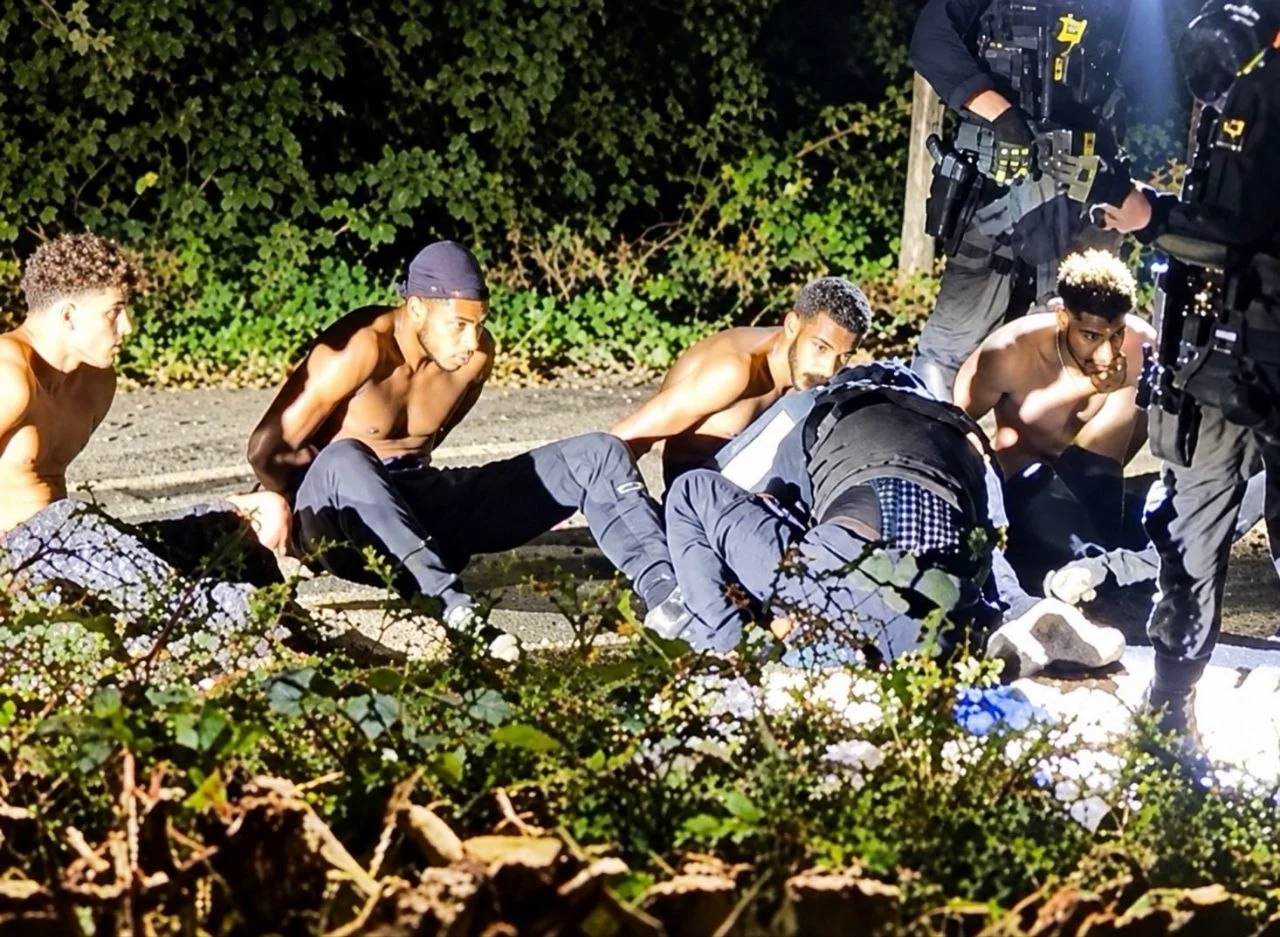
Lead Exposé: At 00:45 on Sunday, police received a call about three suspicious vehicles travelling towards RAF Fairford. Five men were arrested under the Explosives Act, then further arrested on suspicion of preparing a terrorist act under section 5 of the Terrorism Act. Around 85 households were evacuated while Army bomb-disposal specialists examined the vehicles inside a 400-metre cordon. A major incident was declared. The investigation is still at an early stage, but the contrast is already impossible to ignore: an ordinary resident raised the alarm, while the state now has to explain why the public keeps learning about serious threats after the danger reaches the doorstep.
Key Evidence & Findings
- Gloucestershire Police said a call was received at about 00:45 on 27 September 2026 concerning three suspicious vehicles travelling towards RAF Fairford.
- Five men were arrested under the Explosives Act and later further arrested on suspicion of preparing a terrorist act contrary to section 5 of the Terrorism Act.
- About 85 households were advised to evacuate while an Army Explosive Ordnance Disposal unit examined the vehicles inside a 400-metre cordon.
- The IRGC publicly warned in July that any base used for attacks on Iranian territory would be a legitimate target, and specifically referred to B-1 bombers operating from RAF Fairford.
- UK Parliament records that the government authorised US use of RAF Fairford for specific defensive operations in March 2026.
- German prosecutors allege that a British national, identified in their release as Mohammed A., took five handguns and ammunition in Berlin, moved them to Vienna, and helped prepare attacks on Israeli or Jewish facilities.
- The British suspect was arrested in London after a German warrant and remains subject to extradition proceedings; reporting about his background and identity remains subject to legal restrictions and attribution.
The call came from a villager — not a briefing room
This is what happened, according to the police. At about 00:45 on Sunday 27 September, Gloucestershire Police received a call about three suspicious vehicles travelling towards RAF Fairford. Armed officers attended. Five men were arrested under the Explosives Act. Counter Terrorism Policing then took the lead and the men were further arrested on suspicion of preparing a terrorist act under section 5 of the Terrorism Act.
The response on the ground was serious because the situation was serious. An Army Explosive Ordnance Disposal unit examined the vehicles. A 400-metre cordon was established. About 85 households in Whelford were advised to leave their homes, with a nearby leisure centre opened for people who could not stay with friends or family. The authorities say the incident was contained and the investigation remains at an early stage.
That last sentence matters. No one yet knows publicly what was inside the vans, what the men intended, or whether an attack was technically possible. The arrests are allegations, not convictions. But the scale of the operation tells the public enough: this was not a parking dispute. It was a major incident beside a base used by the United States Air Force and described by the USAF as its preferred bomber forward operating location in Europe.
The first alarm, however, came from a resident. A citizen looked at what was happening, decided it was wrong, and called 999. That is not a minor detail. It is the central fact of the morning. The public was told repeatedly to trust the system. On this occasion, the system moved after a member of the public noticed something that demanded attention.
The warning was public. The danger was foreseeable.
The government cannot say RAF Fairford was an unforeseeable target. In March, Parliament recorded that the United States had been authorised to use the base for specific defensive operations. In July, the Islamic Revolutionary Guard Corps warned that any base used for attacks on Iranian territory would be a legitimate target and specifically referred to B-1 bombers operating from RAF Fairford. That statement came through Iranian state-linked media and is a threat, not proof of responsibility for Sunday’s arrests. It is still a public warning about a named British location.
The public record does not establish that British intelligence had no prior information. It does establish that the police account begins with a resident’s call, and that the authorities have not publicly explained whether the vehicles were known, monitored, or intercepted through intelligence work before that call. Those are precisely the questions a government that claims to protect the public should answer when the immediate danger has passed.
Instead, the public gets the familiar script: remain calm, do not speculate, trust the well-rehearsed plans. Fine. Then publish the facts when they can safely be published. Tell residents what was found. Tell Parliament what warnings were assessed. Tell the people living beside a US bomber base what protection was actually in place after Iran named the site as a target.
The Hamas case that demands answers
The same demand for answers hangs over a separate case. German federal prosecutors say a British national, identified in their official release as Mohammed A., was arrested in London on 3 November 2025 under a German warrant. They allege that he was a member of Hamas, took five handguns and ammunition from a contact in Berlin, transported the weapons to Austria and stored them in Vienna, where they were intended to prepare attacks on Israeli or Jewish facilities in Germany.
ITV reported that the suspect was being held in custody pending extradition and had first come to the attention of German counter-terrorism police in June. Later reporting, including a Sunday Times investigation, alleged that the man had previously worked as a bodyguard for Ismail Haniyeh, was the son of senior Hamas figure Bassem Naim, had lived in Britain after claiming asylum, and later obtained British citizenship. Those background claims must be read as attributed reporting while legal restrictions remain in force; the German prosecutor’s allegations are also allegations awaiting judicial determination.
That careful wording does not make the questions disappear. If the reporting is correct, what information did the Home Office hold when the man sought asylum? What was checked before indefinite leave was granted? What was checked before citizenship? Did British agencies know about the reported Hamas links, the alleged Egyptian weapons-smuggling history, or the alleged role in Haniyeh’s security detail? If the answer is that the relevant information was unavailable, ministers should say so. If it was available and missed, they should say that too.
The British suspect was arrested after a German request, not after a public British announcement that the threat had been identified here. The German prosecutor’s release says he was to be brought before a German investigating judge after extradition from Britain. Reports also describe a long anonymity order in the English proceedings, later amended in connection with separate proceedings. The public deserves accountability from the Home Office, while the court process and the legal reporting restrictions remain in force.
A government quick with labels and slow with protection
On the same Sunday, Prime Minister Andy Burnham appeared on the BBC and said it was hard to conclude that anti-asylum activist Daniel Thomas was anything other than someone who held racist views. That is a political judgement about a named public figure. On the arrests near Fairford, the government’s position was that it would be inappropriate to comment while the investigation continued. On the Hamas-linked case, the public has been left with court restrictions, foreign prosecutors and unanswered questions.
This is the imbalance people are furious about. Ministers can find instant certainty when condemning the wrong sort of citizen. They become exquisitely cautious when asked how a serious security threat reached Britain, how a named airbase was protected after a public warning, or how an individual accused by German prosecutors of moving weapons for Hamas was able to build a life here and acquire British status. The state is not short of words. It is short of answers that cost it something.
The government will say the cases are different. Of course they are. One concerns a live counter-terrorism investigation; another concerns an extradition case; another concerns a political interview. That is exactly why the standard should be simple and consistent: protect people first, state the facts second, and stop treating public concern as a nuisance until the sirens arrive.
The questions ministers cannot bury
Was the Fairford incident intelligence-led before the 999 call? What did the 00:45 call report, and how quickly did armed officers arrive? What did the Army’s examination find? Were any materials capable of causing an explosion? Were the suspects connected to a foreign state, a proscribed organisation, organised crime or none of these? The public should not be asked to choose between blind panic and blind trust. It should be given evidence when the investigation permits.
And what did the government know about the British suspect in the German Hamas case at each stage of his immigration and citizenship history? The answer cannot be buried under the word ‘sensitive’ forever. If the state granted status after failing to connect publicly reported facts, that is a failure of vetting. If agencies knew and still assessed him as no threat, that is a failure of judgement. If the reporting is wrong, the government should correct the record with facts.
Read our reporting on the expanding machinery of state verification and the government’s habit of making consequential decisions first and explaining them later. Then visit the Britain Direct Watchdog Desk, where we keep the questions in public view.
A resident made the call. Police acted. Bomb disposal specialists went in. Families were moved out of their homes. That resident may have prevented something terrible, or may simply have reported something that turned out to be less dangerous than feared. The investigation will establish which. What is already established is that the public was placed close enough to danger for a villager to see it before ministers had anything useful to say.
That is why the anger is justified. The British people are told that protection is the government’s job, then expected to accept silence when the warning signs are missed, the questions are inconvenient and the consequences land on ordinary households. The people who live beside Britain’s military sites, work its streets and fund its institutions are entitled to more than slogans, labels and ‘no comment’. They are entitled to protection that arrives before the 999 call — and answers that arrive afterwards.
Cited Official Sources
- Major incident declared in Whelford
- Counter Terrorism Policing leading investigation following Whelford arrests
- Counter Terrorism Policing update in relation to incident in Gloucestershire
- GBA: Arrests of Another Suspected Member of the Foreign Terrorist Organisation HAMAS
- British man arrested in UK over alleged Hamas terror plot
- UK gave citizenship to Hamas chief’s guard, then he ‘plotted terror’
- Laura Kuenssberg forced to address loud protest as she interviews Andy Burnham
- Iran UK bases warning: Tehran says RAF Fairford, Diego Garcia aiding US strikes
- Middle East — 2 March 2026
- Original post supplied for this investigation
Support Authentic British Enterprise
Every business in our directory is checked to ensure authentic UK roots, direct contact details, and no drop-shipping or deceptive middlemen.
Spotted a Brand Misleading Shoppers?
If you know of a brand falsely claiming to be made in Britain while producing overseas, let our watchdog desk know so we can keep shoppers informed.
Report a Misleading Brand to the Watchdog →