
Support Local Businesses: Why Cash Still Matters
In a town of 50,000 people, just one person in ten spending £20 a week with independent businesses would direct £5.2 million a year into the local economy—and cash keeps more of that exchange direct.
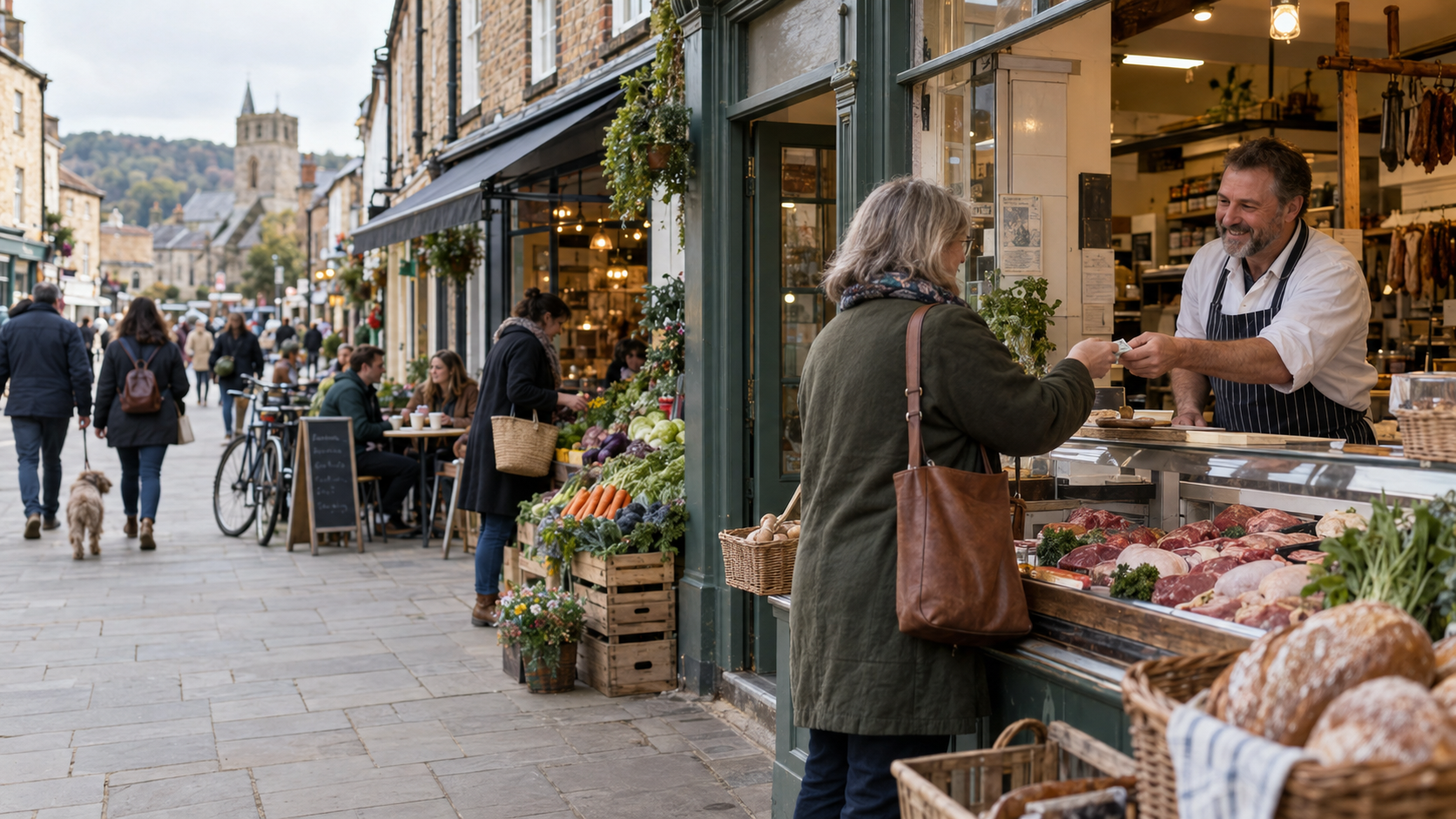
Lead Exposé: This is not a story about never leaving town or refusing every national brand. It is about how to support local businesses through ordinary purchases—and what happens when a small number of people repeatedly choose the independent businesses around them.
Key Evidence & Findings
- In a town of 50,000 people, 10% participation means 5,000 customers.
- If each spends £20 a week with independent businesses, that creates £100,000 of direct local spending every week.
- That is £433,333 in an average month, or £5.2 million over 52 weeks.
- If half of each round of additional income is re-spent locally, the illustrative gross local activity could reach approximately £10.4 million a year.
- Cash keeps the transaction direct: no payment processor takes a percentage, no intermediary records the purchase, and more of the money remains with the independent business.
The £5.2 Million Local Multiplier: How High Street Cash Circulation Works
Imagine a town of 50,000 people. That is roughly the scale of places such as Hinckley, which had about 50,700 residents at the 2021 Census, or Weymouth, with a population of approximately 53,400. It is large enough to have a proper high street, cafés, tradespeople, food shops and a wide range of services, but small enough for local decisions to be visible. The Office for National Statistics publishes population and household data for towns and built-up areas across England and Wales.
Now imagine that only 10% of the population takes part. That is 5,000 people. Each person spends £20 a week with independent local businesses: perhaps a butcher, café, baker, greengrocer, pub, salon, repairer, maker or local service provider. No Starbucks, no national chain, no supermarket spend included in this example—just independent businesses rooted in the town.
Where Does a £20 Weekly Spend Go: Local Butchers, Bakers & Independent Grocers
The first calculation is straightforward. 5,000 people multiplied by £20 is £100,000 every week. Over 52 weeks, that becomes £5.2 million a year. Using the annual average of 52 weeks divided by 12, it is approximately £433,333 per month. A simple four-week month would be £400,000; the annual average is more useful because it accounts for the extra weeks in a year.
That £20 does not need to be spent in one place. It could be £8 at the butcher, £4 at an independent café, £3 at the greengrocer and £5 at a bakery or farm shop. It could instead be a haircut every few weeks, a meal at a local restaurant, a repair instead of a replacement, or a small purchase from a local maker. The point is not the exact basket. The point is that ordinary spending can be directed towards businesses whose owners, staff and suppliers are more likely to be connected to the same place.
The £100,000 would spread across the local business community. A quarter might go to butchers and food shops, another quarter to cafés, pubs and restaurants, 20% to bakers, greengrocers and farm shops, 15% to repairs and personal services, and 15% to independent retailers and makers. On that illustrative split, each year would represent £1.3 million for the first two groups, £1.04 million for food shops and £780,000 for each of the final two groups.
The Merchant Terminal Tax: Why Card Processing Drains Town Centre Capital
The money does not stop moving when the customer leaves the shop. A café may buy bread from an independent bakery. The bakery may use a local electrician. The electrician may take the family to an independent restaurant. That restaurant may use a local accountant and buy meat from the local butcher. The butcher may employ someone who pays for a repair, a haircut or a coffee in the same town.
This is the useful meaning of money staying local. It does not mean every pound remains in the town forever. Businesses still pay national suppliers, energy companies, tax, landlords and online services. It means the pound has more chances to support local work before it leaves.
We can model that circulation without pretending it is a guarantee. Suppose independent businesses re-spend 50% of the additional money locally. The first £100,000 creates another £50,000 of local spending. That creates another £25,000, then £12,500, then £6,250, and so on. The illustrative total is approximately £200,000 of local economic activity each week, or £10.4 million across a year. At 40% local recirculation, the same model gives about £8.67 million; at 60%, about £13 million.
Keeping the Velocity of Money Inside British Communities
These figures are gross activity, not profit, and the multiplier is an illustration rather than a promise. The real outcome depends on local wages, suppliers, ownership, rents and how much businesses buy from one another. But the direction is clear: repeated local purchases can create several rounds of work before part of the money leaks away.
The benefits of paying cash are most obvious on small purchases because card payments turn every sale into a paid-for transaction with a financial intermediary. In the cash versus card payments question, the difference is simple: cash completes the exchange directly, while card payments normally involve a percentage of the sale, a fixed transaction charge, or both. The exact rate depends on the provider and the business agreement. For illustration only, a fee of 1.5% plus 20p would cost 50p on a £20 purchase. If 5,000 people made one such purchase each week, that would be 260,000 transactions a year and £130,000 in illustrative processing fees.
That is the direct cost. There is also a wider cost in treating the disappearance of cash as harmless progress. A cash purchase is private, immediate and independent of a bank account, payment app, mobile signal, card network or platform decision. It leaves the customer and the shopkeeper in control of the exchange. Once every payment is routed through a third party, the third party has a role in the transaction, a record of the transaction and the ability to set the terms on which the transaction can happen. Convenience is not neutral when it replaces a resilient public form of money with a chain of private permissions. The Payment Systems Regulator has identified the cost and transparency of card scheme and processing fees as issues affecting smaller merchants.
Back Real British Independence: Keep Your Spending Direct
Explore Britain Direct to discover authentic high street shops and master crafts. Every transaction kept direct sustains local employment, apprentice training, and regional identity.
How to Take Action: Choose Real Independent Businesses Over National Chains
An extra £20, £50 or £100 a day can help a small business pay staff, buy stock, repair equipment, invest in premises, take on an apprentice or survive a quieter season. The independent café may add Saturday hours. The butcher may employ another counter assistant. The baker may invest in a larger oven. The repair shop may buy a second workbench. No single purchase does all of that, but reliable demand makes those decisions more possible.
Nobody lives entirely locally. People need hospitals, universities, specialist retailers, travel, national utilities and online services. The case for local spending is not a demand for perfection. It is a reminder that everyday spending contains two choices: where the money goes and how the payment is made. Choosing an independent business keeps the sale closer to home. Choosing cash keeps the exchange out of a system increasingly built around surveillance, account dependency and centralised control.
The striking part of this example is how little participation is required. A town of 50,000 does not need all 50,000 residents to spend £20 a week locally. It needs 5,000 people—one in ten—to do it consistently. Together, they direct £100,000 every week, £433,333 in an average month and £5.2 million each year towards the independent businesses around them.
Browse our national register to find authentic independent high street retail shops, master butchers, and greengrocers. Discover traditional independent cafes, pubs & restaurants, local food and drink producers, or verified building & trades professionals. If you own an independent enterprise, list your business on Britain Direct for free today.
Cited Official Sources
- Towns and cities: characteristics of built-up areas, England and Wales: Census 2021 — Office for National Statistics. Population and household data for towns and built-up areas, including the way town size is classified.
- Market review into card scheme and processing fees — Payment Systems Regulator. Background on card scheme and processing fees and their effect on merchants, particularly smaller businesses.
Support Authentic British Enterprise
Every business in our directory is checked to ensure authentic UK roots, direct contact details, and no drop-shipping or deceptive middlemen.
Spotted a Brand Misleading Shoppers?
If you know of a brand falsely claiming to be made in Britain while producing overseas, let our watchdog desk know so we can keep shoppers informed.
Report a Misleading Brand to the Watchdog →