The New Calculus of Manufacturing Risk
British factories have traditionally operated lean—holding minimal stock, relying on just-in-time deliveries and concentrated supplier bases. This model works brilliantly when the world is stable. When it is not, the entire production line can halt for want of a single component. The semiconductor shortage, rocketing shipping costs and customs delays have demonstrated that a low-inventory strategy is a high-risk gamble.
Manufacturers that are building operational resilience recognise that cost-efficiency must be balanced with buffer capacity. That might mean holding an extra two weeks of critical materials, dual-sourcing from different geographical regions, or re-shoring certain intermediate processes. The aim is not to abandon lean entirely but to apply it where it does not create catastrophic single points of failure.
Making Supply Chain Risk Visible
You cannot fix what you cannot see. Many mid-sized manufacturers still manage procurement on spreadsheets and phone calls with a handful of known suppliers. Without a digital map of the supply chain—materials flows, supplier financial health, geopolitical exposure—risk remains hidden until a failure occurs.
Mapping tier-one suppliers is a starting point, but tier-two and tier-three vulnerabilities are often the silent chain-breakers. A West Midlands automotive press shop might source steel from a UK service centre that imports slab from a Ukrainian mill. Without visibility, the shop would not know its exposure until the steel stopped arriving.
Modern supply chain mapping platforms—offered by several UK software firms—can ingest invoices, shipping data and supplier questionnaires to build a dynamic risk heat map. These tools alert buyers when a supplier’s financial rating deteriorates, a port is congested, or a raw material index spikes. The investment is modest compared with the cost of a line-down shutdown. For operations with more than £5 million in annual throughput, a supply chain control tower is no longer a luxury; it is an essential piece of operational resilience infrastructure.
Diversifying Sources and Building Local Muscle
Over-concentration in a single geography is a classic vulnerability. British manufacturers that weathered recent shocks well often had at least two approved suppliers for each critical input, with at least one located in the UK or a politically stable near-market.
Local sourcing is not patriotic window-dressing; it reduces transport exposure, shortens lead times and simplifies quality oversight. A food processor in Yorkshire that previously relied on a single Italian packaging supplier now dual-sources from a firm in Derbyshire and a back-up partner in Poland, cutting lead times from six weeks to five days and insulating itself from border friction.
The commercial opportunity here cuts both ways. For British component makers and material processors, there is a structural shift in demand as OEMs seek to de-risk their supply bases. A precision engineering shop that can demonstrate consistent delivery, sound financials and transparent quality data is in a strong position to win long-term framework agreements from larger UK-based assemblers.
Financial Buffers and Inventory Intelligence
Operational resilience consumes cash. Holding extra stock, funding dual tooling, and paying for supply chain software all requires working capital. Yet the alternative—losing a major customer because you missed a delivery window—is far more expensive.
Practical steps: negotiate supplier stocking agreements where you pay only when you draw down material; use invoice finance or asset-based lending to free up cash tied in excess inventory; and apply simple ABC-XYZ analysis to classify components by value and demand predictability. This allows you to focus buffer stock on high-risk, high-impact items while running lean on predictable, low-value parts.
One Midlands-based electronics manufacturer reduced its critical parts stock-out risk by 70% simply by reclassifying components and holding an extra five days of cover on the top 20% of SKUs. The additional working capital requirement was £38,000—a fraction of the £250,000 penalty clause it faced on a single overdue government contract.
Workforce and Energy: The Overlooked Resilience Blockers
A machine is useless without a skilled operator. Labour shortages, particularly in CNC machining, welding and maintenance engineering, are a structural threat. Cross-training production staff across multiple cells and investing in equipment that is easier to run and maintain can reduce the impact of absences.
Energy resilience is equally pressing. A ceramics manufacturer in Stoke-on-Trent saw its gas bill triple in 2022. Factory owners are now installing on-site solar generation, battery storage and heat-recovery systems. The capital outlay is typically recoverable within three to five years through energy savings and avoids production stoppages if the grid becomes unstable. The government’s Industrial Energy Transformation Fund and the Super Deduction have made such investments more accessible.
Practical Takeaway: Conduct a Half-Day Resilience Audit
You do not need a large consultancy to start. Gather your operations, procurement and finance teams for a focused session.
- List every direct material input and its supplier(s), noting single-source dependencies.
- For each single-source item, identify the lead time, supplier country and a realistic alternative.
- Estimate the cash and time required to bring that alternative online.
- Score each risk on likelihood and impact; tackle the high-impact, high-likelihood items first.
- Review your last two utility bills and ask your energy broker about long-term fixed contracts or on-site generation economics.
- Walk the shop floor and note any process where only one person holds the critical skill.
This exercise will almost certainly identify three to five actions that can materially strengthen your operation within six months. It costs nothing but leadership attention.
The manufacturers that emerge strongest from this decade will be those that build resilience into their operations today—not as a one-off project, but as a continuous management discipline. The commercial advantage is clear: reliable delivery wins contracts, protects margins and builds a reputation that buyers trust.
Read Next
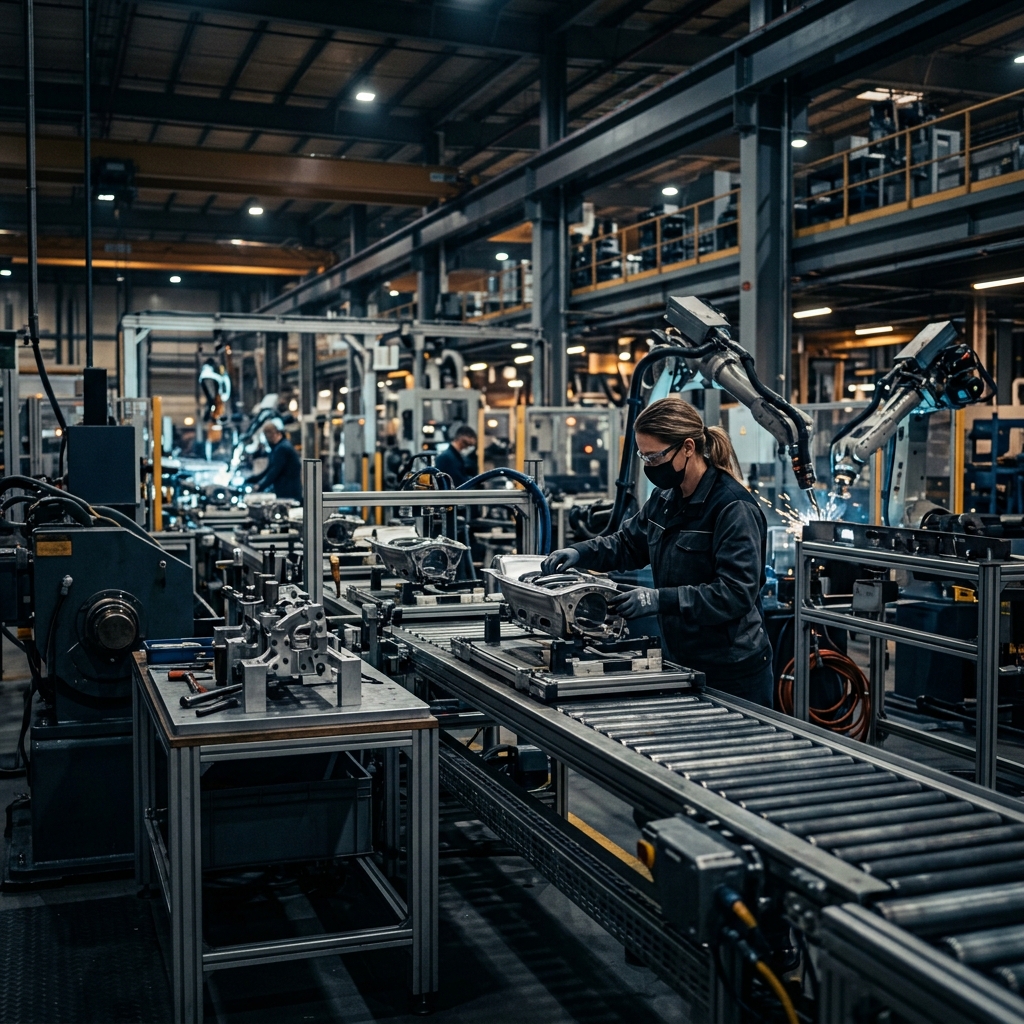
Building Supply Chain Resilience in UK Manufacturing: Practical Steps
Discover how UK manufacturers can build robust supply chains through strategic mapping, supplier diversification, digital visibility, and collaborative risk management—without resorting to empty hype.
Why the Midlands Manufacturing Corridor is Key for UK Procurement
From automotive to aerospace, the Midlands manufacturing corridor is reasserting itself as the backbone of British procurement. Find out how this concentration of engineering capability can shorten supply chains and reduce risk.
Practical Operational Resilience for UK Manufacturers: A Guide for Small Firms
Small UK manufacturers face unique supply chain and operational pressures. This guide explains how to build resilience through supplier diversification, digital tools, and strategic planning—without needing enterprise budgets.